Mandopop megastar Jolin Tsai wins best album at Taiwan's Golden Melody Awards
Tsai won for her concept album Pleasure, which was inspired by the seven deadly sins.
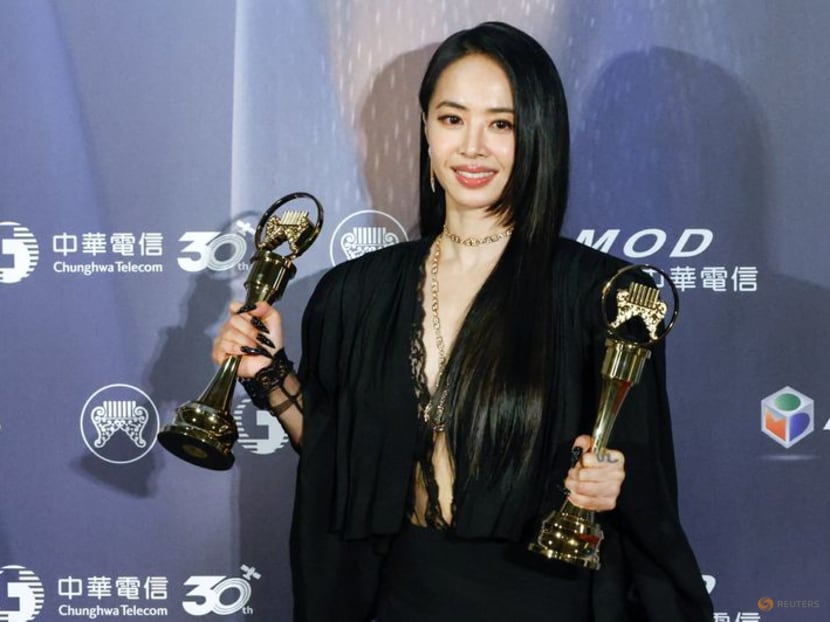
Jolin Tsai poses for a photograph after receiving the Album of the Year award for Pleasure at the Golden Melody Awards in Taipei, Taiwan, Jun 27, 2026. REUTERS/Ann Wang
Mandopop megastar Jolin Tsai won album of the year on Saturday (Jun 27) in Taipei, at one of the most prestigious entertainment events in the Chinese-speaking world, Taiwan's Golden Melody Awards.
While Taiwan has only 23 million people, its pop music scene has an outsized cultural influence across East Asia, especially in China, thanks to creativity unfettered by censorship or government control.
Tsai, who cites the likes of Madonna and Kylie Minogue as influences, won for her concept album Pleasure, which was inspired by the seven deadly sins. She also won best female Mandarin singer.
"Making this album, for me, felt like I had been comfortably sitting in the passenger seat for a long time, and now I've finally taken the steering wheel myself – driving forward with all the partners who, like me, understand my music," she told the audience.
Tsai, 45, has been hugely popular across the Chinese-speaking world since the release of her debut album in 1999.
The awards celebrate not only Mandopop but artists singing in Taiwanese – also known as Hokkien or Hoklo – Hakka and indigenous languages like Paiwan, once suppressed but now supported and promoted by Taiwan's government.
Best Hakka singer Sarah Chan, who gave her acceptance speech in Hakka, Mandarin and English for the album Blue Hour Bloom, said the recording had a much broader meaning for her.
"This Hakka-language album gave me the chance to speak more Hakka with my mother at home, and to have more exchanges with my family," she said.
Hakka make up about one-fifth of Taiwan's population, but many do not speak the language – which has five different dialects across the island – fluently after decades of its public use being discouraged.
Chinese artists in recent years have largely stayed away from the Golden Melody Awards given tensions between democratically governed Taiwan and China, which views the island as its own territory over the Taipei government's objections.
While China's Jude Chiu and Shan Yichun received nominations, neither attended, though Hong Kong's Karen Mok both sang and presented, her first appearance at the awards in a decade.