‘Harder to sing’: Music industry veterans Dick Lee and Jeremy Monteiro weigh in on NDP 2026 songs debate
Some commenters say this year's NDP tracks don't feel like traditional National Day anthems. Local music industry icons Dick Lee and Jeremy Monteiro weigh in on the debate and the role of younger voices in shaping Singapore's musical identity.
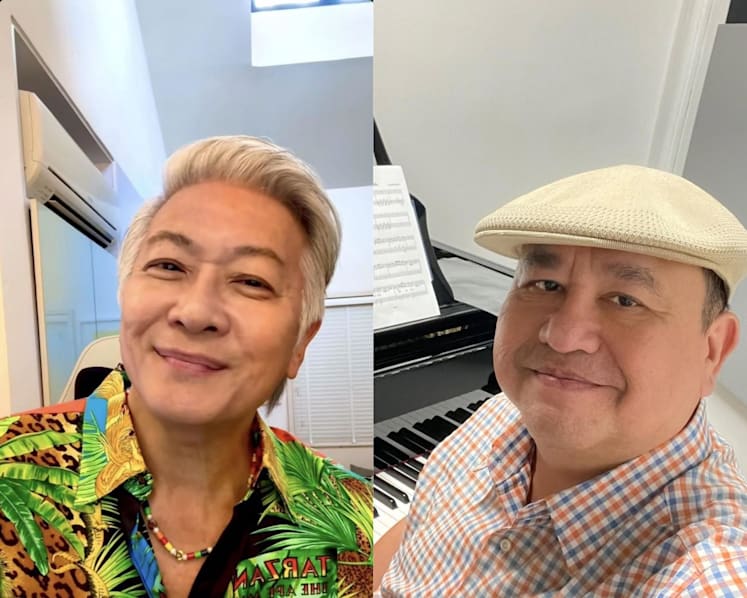
Dick Lee (left) and Jeremy Monteiro are veterans of the Singapore music scene. (Photo: Instagram/@dickleeparadise, Facebook/Jeremy Monteiro)

This audio is generated by an AI tool.


National Day may be over, but the debate over this year's National Day Parade (NDP) songs is still playing out online, with veterans from the local music scene – singer-songwriter Dick Lee and jazz pianist and composer Jeremy Monteiro – weighing in with their thoughts on the debate.
The discussion centres on the three original theme songs released for NDP 2026: Giants, performed by Iman Fandi and written by Weish; Sparkle, performed by Gareth Fernandez and Dru Chen; and You'll Be Okay, performed and co-written by Jasmine Sokko.
The songs form the three-track Go Beyond: NDP 2026 Album, the first time the NDP's musical soundtrack has been presented as an album. Music director Bang Wenfu said the wider range of musical styles was intended to reflect Singapore's diversity and offer different song choices for Singaporeans.
Online, some people have questioned whether the songs work as NDP anthems, with comments coming from people of different ages and backgrounds.
Some said the songs were "too heavily autotuned" to sing along to, while others felt they were less immediately memorable than past NDP songs. One commenter wrote that the songs were “difficult to sing along with, compared to previous years' songs”, while another said they “don't sound or feel like NDP songs, but just normal songs about home and Singapore”.
At the same time, others welcomed the opportunity for younger local singers and songwriters to contribute to the NDP soundtrack.
MAKING SPACE FOR YOUNG VOICES
Veteran musician Monteiro, who was the musical arranger for the Hugh Harrison-penned songs Stand Up For Singapore in 1984 and Count On Me, Singapore in 1986, and who was awarded the Cultural Medallion by the National Arts Council in 2002, weighed in on the discussion in a Facebook post on Monday (Aug 10).
He acknowledged one of the more common criticisms: that some newer NDP songs are harder for large crowds to sing.
“Some of the newer songs are genuinely harder to sing. That complaint is fair,” he wrote. “They are often written for trained voices, with intervals and runs that suit a soloist on a stage more than a crowd on a field, and many of us in the older generation simply cannot get our voices around them.”
But Monteiro argued that this does not necessarily mean the songs have failed to connect with younger Singaporeans.
He pointed to younger songwriters and performers behind more recent NDP songs, including The Road Ahead in 2021, Not Alone in 2024 and Here We Are in 2025, and argued that younger Singaporeans are more comfortable with the musical language of these songs.
“Our young people can sing them. Easily, from memory, with feeling, because that is the musical language they grew up speaking,” he wrote.
He compared this with the way songs such as Stand Up For Singapore resonated with his own generation.
His broader point was that NDP songs, like Singapore's musical tastes, will inevitably evolve and that younger voices are crucial to shape that soundtrack.
A PUBLIC COMMITTEE DECIDING SONGS FOR SINGAPORE
Singer-songwriter and composer Lee, who composed the songs We Will Get There in 2002 and Our Singapore in 2015, and was also awarded the Cultural Medallion in 2005, offered a different proposal in an Instagram Reel posted on Tuesday.
Lee argued that the selection of NDP theme songs should involve a broader cross-section of the public, rather than being decided by the changing creative teams behind each year's parade.
He suggested forming a special public committee made up of “ordinary citizens and musicians”, with people from different ages and backgrounds.
The committee could then select a song that it believes would resonate across a broader section of Singaporeans, he said.
Lee also stressed that other Singapore songs should continue to be included in the NDP, even if they are not selected as the official theme song. These songs, he said, can help “colour the parade”.
NDP SHOULDN'T BE THE ONLY EVENT THAT INSPIRES LOCAL SONGWRITERS
Both Lee and Monteiro's comments point to a bigger question about what happens to Singapore's music beyond August each year.
Lee said: “It's very important for us to create and build our song bank. We're such a young country.”
He cited songs such as Bunga Sayang, which he composed in 1995, and the classic track Home, composed in 1998, as examples of Singapore songs that were not written specifically as NDP theme songs but have nevertheless become closely associated with the country.
Monteiro echoes the sentiment, stating: "Our catalogue is an inheritance, still growing, with room in it for everybody. These songs make us feel Singaporean. They make us feel our rootedness. They make us feel our togetherness."
Lee added: “It shouldn't be just NDP that inspires local songwriters to write songs about Singapore for Singapore.
"It's important to have that sense of place of where we come from in our songs and music anyway. So keep writing.”