Not just for Hari Raya: Meet the ‘Nusantara Otaku’ who wears traditional Malay clothes every day
At first glance, he looks like he is headed to a wedding – but he isn’t. For Hafiz Rashid, wearing traditional Malay clothing every day is a unique and personal way of expressing his identity and passion for regional heritage.
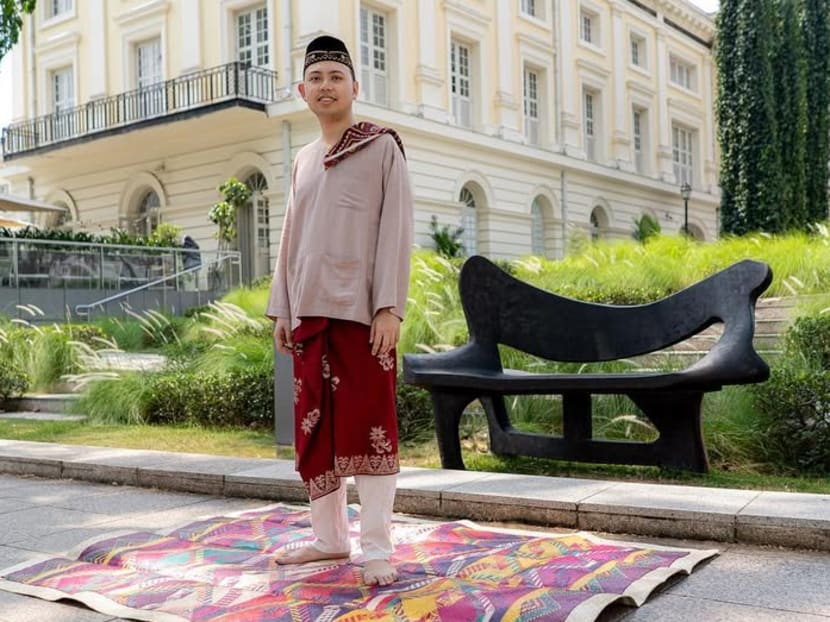
Hafiz Rashid is a freelance storyteller who wears traditional Malay and regional attire every day. (Photo: Hafiz Rashid)

This audio is generated by an AI tool.


The first time I saw Hafiz Rashid, I knew I would not forget him.
The 33-year-old was dressed in traditional Malay attire and accessories: baju Melayu, a songkok with neat embroidery, a kain samping songket, complete with a batik kipas and other traditional accessories.
I could not help but stare, admittedly slightly confused.
We were at a book event. There was no costume theme or any memo to dress traditionally. At first, I assumed he was on his way to a wedding or participating in a programme that required such elaborate dress, like a traditional dikir barat competition.
Whatever his reasons were, he stood out among the rest of us in our usual shirts, jeans and dresses.
It was only later, as I got to know him, that I realised there was no wedding nor traditional music competition. Just Hafiz’s everyday wear – his equivalent of the oft-talked-about Singapore men’s Uniqlo "uniform".
Much later, when we sat down to talk about his journey in fashion, I brought up the first time I saw him. He chuckled and said he receives such reactions fairly often – sometimes from well-meaning people in genuine awe, other times with a more borderline mocking edge.
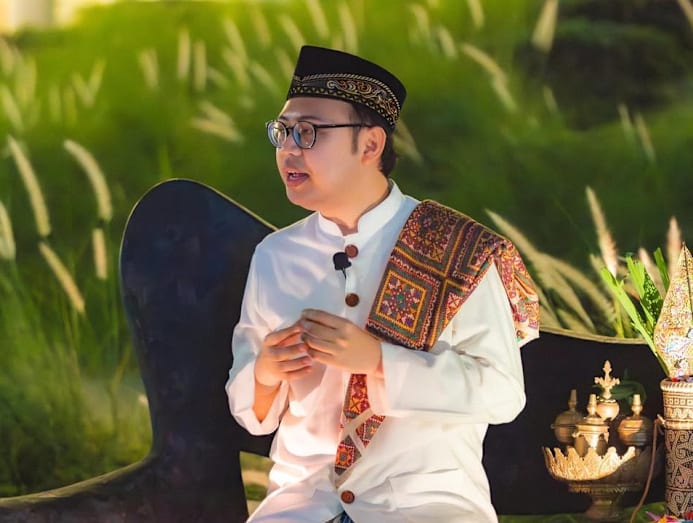
Either way, he is hardly bothered.
“My clothes – I wear them because it’s part of who I am, it’s my identity,” he said.
Hafiz is a freelance storyteller and part of Rewang Collective, a group dedicated to celebrating and preserving Malay heritage through food, storytelling and communal practices.
He often sheds light on stories from the Nusantara – or the Malay archipelago, which spans Singapore, Malaysia, Indonesia, Southern Thailand and the Philippines – and is deeply passionate about the region’s culture and history.
He is even known as the “Nusantara Otaku", a nickname coined by local playwright Alfian Sa'at, drawing from the Japanese word for a devoted enthusiast. Quirky and endearing, the name stuck.
“Wearing the clothes and fashion of the Nusantara is just one small way I share my love for it,” Hafiz added.
A LOVE THAT GREW ORGANICALLY
When people see or hear the way Hafiz expresses his passion for the region's traditional fashion, a common question is whether he grew up surrounded by that love. But that was not really the case.
“I grew up like anyone else,” said Hafiz, who is the eldest of three boys. “My parents had fairly normal jobs, and while they appreciate the interest, they – and my two brothers – aren’t as interested in nor passionate about it as I am.”
In fact, the first time Hafiz, as he puts it, “fell into the beautiful rabbit hole of Nusantara heritage” was when he had just turned 20, during the limbo between polytechnic, where he studied biomedical engineering, and mandatory National Service (NS).
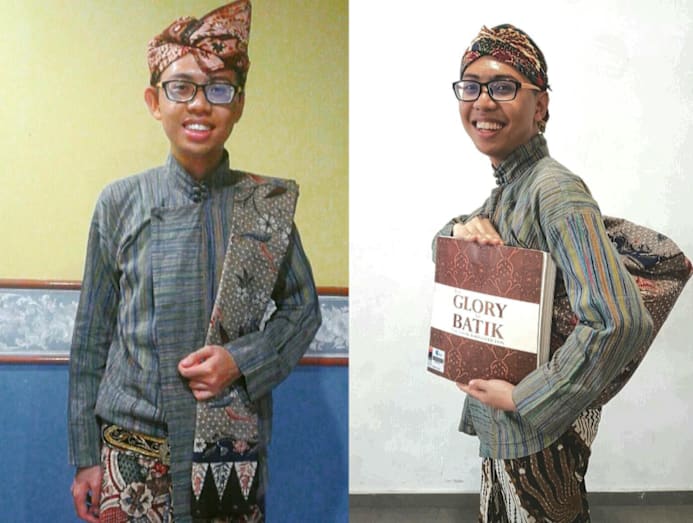
“In 2013, I came across the Malay Cultural Festival at Kampong Glam’s Malay Heritage Centre. There was an exhibition called Ilham Alam (inspiration from nature) and I was blown away,” he said.
The exhibition initially drew him in due to his existing interest in medicine, but unlocked a deeper interest he never knew existed. It led him to realise how rich his Malay heritage was, with knowledge spanning medicine, science, fashion and the arts.
While waiting for NS to begin, he spent more of his time at the heritage centre absorbing as much as he could. Eventually, he registered to become a docent, giving tours and sharing stories about the exhibitions and the wider heritage scene.
“I was the only one younger than 50 who signed up and attended all the mandatory courses to get certified,” he recalled, chuckling. “Everyone else was a retiree, and people even thought I was there to accompany my parents or grandparents. But no, I was genuinely drawn to the stories and was happy to be there.”
A UNIQUE KIND OF CASUAL WEAR
When he first became a docent, Hafiz rewarded himself by buying a handmade batik shirt – a piece he thought would be nice to wear on the job.
As the months passed, he began wearing different traditional pieces more often. One of them was the classic baju Melayu, a matching top-and-bottom set that Malay men usually reserved for Hari Raya or weddings.
“I thought, why should I only wear this once a year during Hari Raya season, especially if I already feel comfortable in it?” he said. “I know that men used to wear this as everyday wear, with the right fit and materials, and it felt perfect since I was telling stories of Malay and Southeast Asian history.”
With time, his collection grew. He became more aware of the cuts and fits that complemented his body and made him feel most comfortable. He gravitated towards breathable materials suited to Singapore’s weather, namely cotton or linen, and colours that reflected what he already wore every day, such as browns, blacks and reds.
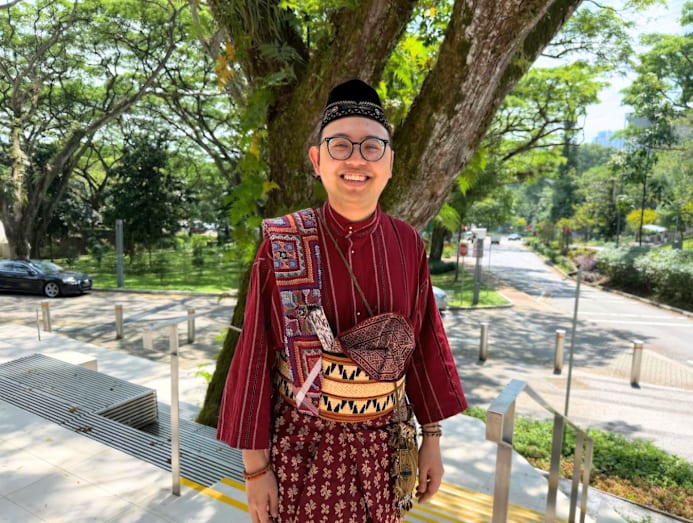
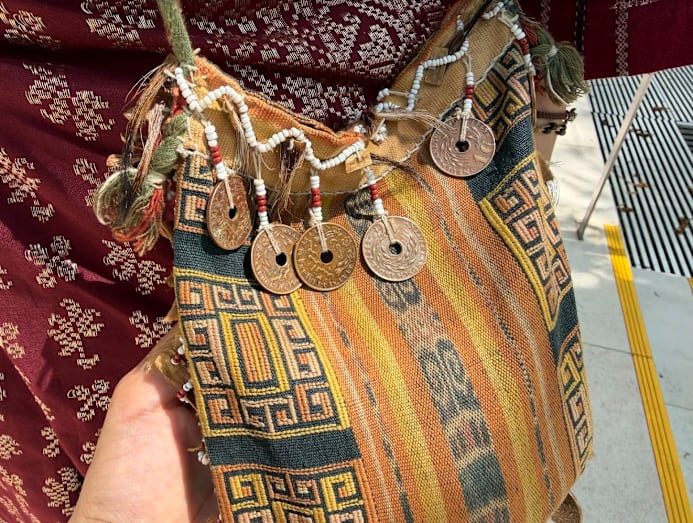
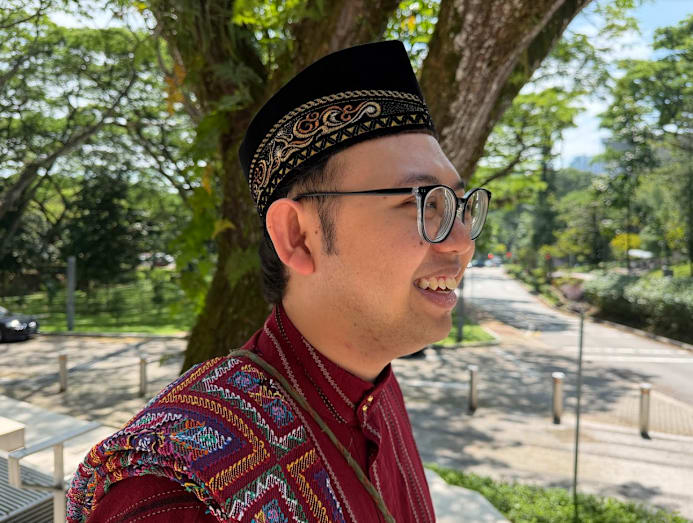
“There were clothes that felt more like a costume in the performative sense – I didn’t want that,” he said. “I wanted to wear clothes that really felt like me, felt like the traditional version of my everyday wear, so I can feel like myself, but elevated.”
Naturally, people who noticed him dressing this way responded in different ways, ranging from genuine awe to bafflement.
“One of the most common questions I’d get is, ‘Not hot ah?’” he said. “The thing is, because I chose the right materials for Singapore’s weather, I know that what I wear isn’t going to be that hot – at least not as hot as most of the stuff made of polyester I used to wear, no matter the design.”
Some moments have stayed with him. Once, while walking around central Singapore, he noticed a group of men who kept staring.
A few times, strangers would stop him mid-step to wish him “Selamat Hari Raya!” or "Selamat pengantin baru!" (Malay for Congratulations to the newlywed), or ask if he was heading to a performance.
“Sometimes I ignore them, sometimes I'll tell them this is just what I wear, and they'd be quite surprised,” he said. “I’m aware some people are just teasing me, but I’m alright with it – most of the time, my clothes open up a conversation.
“People stop me to ask where I got my batik or my sarong, or why I dress this way when there’s no so-called ‘special occasion’, and I’m more than happy to share.”
He is also clear-eyed about value. Traditional pieces are not, in his view, expensive simply because they are branded.
“A lot of us are happy to part with our money for all kinds of luxuries, why shouldn’t our traditional clothes be part of that? We are, after all, paying for an artwork,” he said. “We do not have a brand, but it’s really a lot of hard work and labour to create something as beautiful and intricate as traditional batik or songket.”
Now, Hafiz has dozens of traditional outfits in his collection, ranging from tops and bottoms to accessories and layering pieces. Some were bought, while others were traded, gifted, or passed down from friends.
STORIES OF THE NUSANTARA THROUGH FASHION
Over time, Hafiz has come to see wearing these clothes as part of himself and his identity as a Malay man in Singapore.
“I often feel that people look at other forms of identity making,” he said. “For me, embracing slow fashion through heritage and tradition is part of that.”
He often feels that even though those born here are native to Singapore, they still live with a kind of diaspora-like feeling.
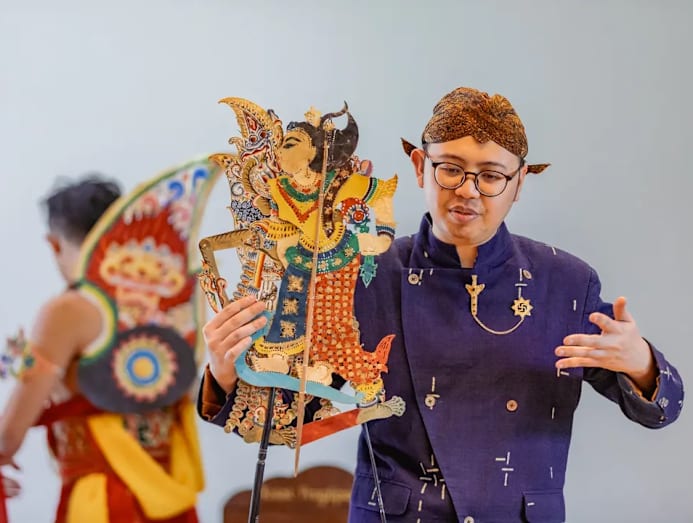
“Perhaps because Singapore progresses, evolves and changes so quickly, the place of our childhood is no longer the place it is now, and there is this strange, indirect and unclear sense of displacement,” he said.
For him, traditional clothing is a way to hold on to that nativity and identity before it slips too far into the past or becomes a mere museum display. It is also a way of making visible the knowledge, labour and beauty embedded in the region’s crafts.
While he identifies broadly as Malay, Hafiz also acknowledges his Boyanese heritage and the diversity within the community itself. His wardrobe comprises a mix of influences – from Boyanese and Javanese pieces to accessories such as a Yakan shoulder sash from Basilan Island in the southern Philippines, and bracelets from the Toraja highlands in South Sulawesi, Indonesia.
Through this, he celebrates the richness of the Nusantara, while expanding the definition of what it can mean to be Malay in Singapore.
“When I put on the clothes I do, I am at ease, I feel at home, I feel belonging, and that the assurance in my identity is strong and rooted,” Hafiz said. “It is something I am proud of, and happy to carry with me on my back – literally.”