Can face yoga and gua sha really slim your face? What experts say
They’re low-cost, low-effort, and all over your feed. But before you add facial exercises to your routine, here’s what experts say these techniques can realistically deliver.
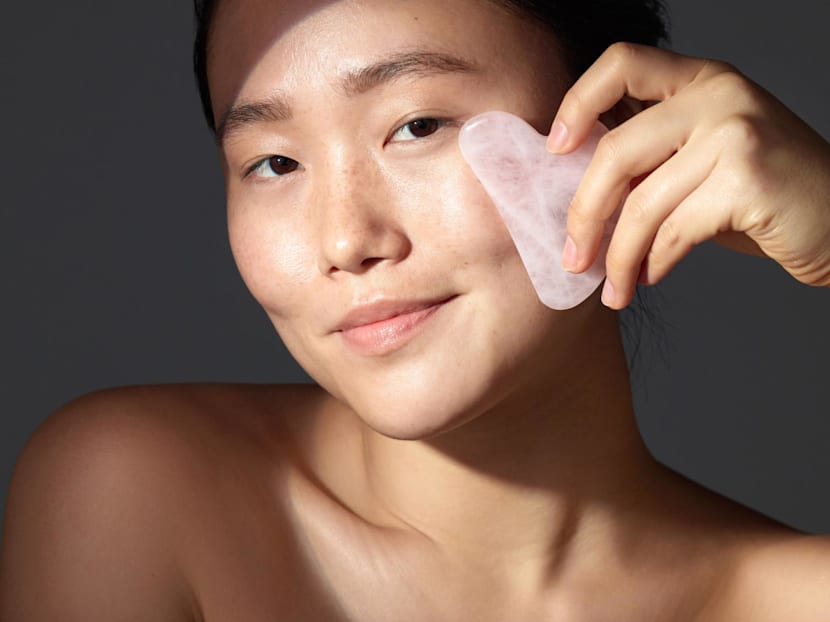
Can you gua sha your way to a slimmer face? (Photo: iStock)

This audio is generated by an AI tool.


Scroll through TikTok or Instagram long enough and you’ll likely come across a tutorial promising a snatched jawline, lifted cheekbones, a visibly “smaller” face – all through a few minutes of daily facial exercises.
From face yoga routines to gua sha, these techniques have surged in popularity as non-invasive alternatives to aesthetic treatments. The appeal is obvious: they’re accessible, relatively low-cost, and can be done at home. But can they actually slim your face – or are the results more subtle than claimed?
To find out, we spoke to a dermatologist and a face yoga instructor about how these techniques work, where they help, and where expectations may need adjusting.
YOUR FACE SHAPE ISN’T JUST ABOUT FAT

Before diving into exercises, it helps to understand what shapes the face in the first place.
According to Dr Angeline Yong, founder of Angeline Yong Dermatology and Sskins Medispa, facial shape is rarely down to a single factor.
“The first thing I explain to patients is that facial shape is usually influenced by more than one factor. It is not just about ‘fat’ alone,” she said. “I typically assess four main components: bone structure, fat distribution, muscle bulk, and fluid retention.”
Bone structure forms the underlying framework and is largely genetic – it cannot be altered without surgery. Fat distribution determines volume in areas like the cheeks or under the chin. Muscle bulk, particularly in the jaw, influences how wide or angular the face appears. Then there’s fluid retention – the day-to-day puffiness that makes the face look temporarily fuller.
“In consultation, I usually break it down by asking: Is this a structural issue, a volume issue, a muscle issue, or temporary puffiness?” Dr Yong explained. “That distinction is important, because each one affects facial shape differently.” Understanding this is key to knowing what facial exercises can – and cannot – realistically do.
Face yoga and gua sha target different things.
HOW THE TECHNIQUES DIFFER
While often grouped together, face yoga and gua sha target different things. “Face yoga focuses on muscle training, while gua sha emphasises circulation and tissue release,” said Jasmine Gabriela Ho, a Face Yoga Method instructor and founder of wellness brand Sunday Seeds.
Face yoga involves controlled movements designed to activate and strengthen facial muscles – similar to resistance training for the body. One of the most widely practised systems is the Face Yoga Method, developed by Japanese instructor Fumiko Takatsu, which combines targeted exercises with massage and acupressure to improve muscle tone and facial function. Ho discovered face yoga in 2020 and later trained under the method.
Gua sha uses a flat tool glided across the skin to stimulate blood flow and encourage lymphatic drainage. Ho, who teaches both disciplines, notes that the two are most effective when combined, ideally beginning with breathwork and neck and scalp warm-ups to address the body as a connected system.
SO WHERE DOES THE “SLIMMER” FACE EFFECT COME FROM?
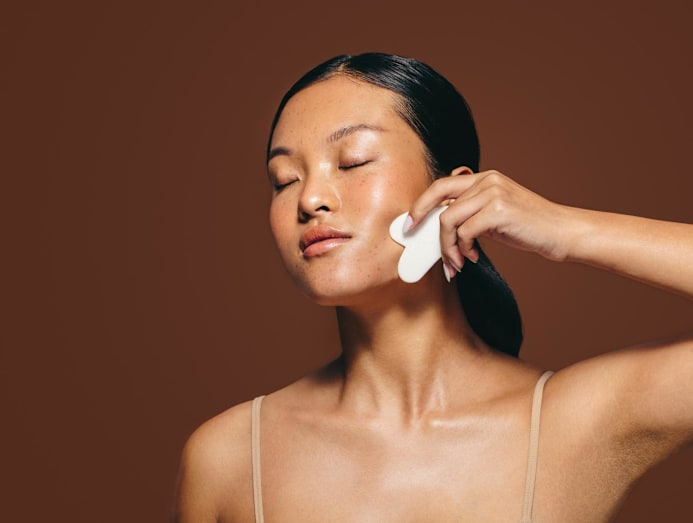
Much of it comes down to changes in fluid and tension – not fat loss or structural reshaping.
“I started doing gua sha about a year ago after coming across tutorials on TikTok,” said Faith Tan, a 29-year-old marketing executive. “My face always looked puffy in the mornings, so I decided to try it. My cheekbones look more defined after, but it’s something I have to keep up – if I skip a few days, my face goes back to normal.”
It’s a pattern the experts recognise. “When we talk about lymphatic drainage or improved circulation, we are usually referring to a short-term reduction in fluid retention,” said Dr Yong. “The face can look more defined for a few hours, or sometimes until the next day.”
Ho draws a distinction with face yoga. “When stagnation is released and stiffened tissues are loosened, blood circulation increases, resulting in an instant lift and glow,” she said. “But face yoga trains the muscles – so consistency is key. Long-term benefits can include a more defined and lifted face line, reduced lines and wrinkles, and less sagging.”
Dr Yong cautions against reading too much into early results. “One of the most misleading claims is that visible definition after facial exercises means the face has actually become slimmer,” she said. “What people often see is a temporary change in puffiness or muscle tension.”
Those prone to fluid retention tend to see the most immediate changes.
WHO ACTUALLY SEES RESULTS – AND WHY
The difference often comes down to what’s driving your facial shape in the first place.
Those prone to fluid retention tend to see the most immediate changes. “Someone who looks more swollen after poor sleep, salty food, or hormonal fluctuations may notice that massage-based techniques help the face look temporarily less puffy and more relaxed,” said Dr Yong.
Jaw tension is another factor. “In some individuals, especially those who clench or grind their teeth, the masseter muscles can become enlarged over time, creating a wider or squarer lower face,” she explained. Relaxation techniques may help, though visible changes are usually modest without medical intervention.

Ho sees value in addressing these patterns early. “Facial asymmetry often stems from prolonged habits like side sleeping, chewing or poor posture,” she said. “By correcting these habits and rebalancing overused and underused muscles, you can improve overall facial symmetry.”
For those with naturally fuller or rounder faces who may not see immediate changes, Ho offers a more encouraging long-term view: “While results may not be as visible at first, as one ages, the loss of fat and collagen will make the face appear less ‘full’ yet still lifted because of good facial habits early on.”
QUICK FIX VS LONG GAME: WHAT TO EXPECT
Tay Liling, a 32-year-old product manager, has rotated between gua sha and face yoga for about two years. “With gua sha, I can see that my face is ‘lifted’ right away, which is very satisfying. Face yoga feels more like going to the gym. It took me about six months to notice a subtle difference in my jaw definition. I only saw it when I looked back at old photos,” she said.
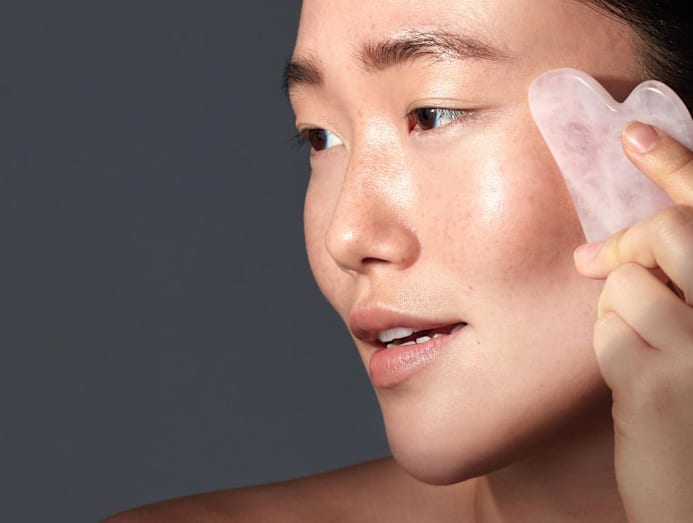
That difference aligns with what the experts describe. Gua sha delivers immediate gratification – the face looks more lifted and less puffy after just a few minutes – but effects are tied to daily fluctuations in sleep, diet and hydration, and rarely last beyond the next day. Face yoga, by contrast, is about retraining muscles over time. “The goal is to undo unhealthy habits and retrain muscles for positive facial posture,” said Ho.
Even so, cumulative improvements tend to be subtle. “The improvement can be real,” said Dr Yong, “but it’s usually a gradual refinement – not a permanent reshaping of the face.”
“I wouldn’t say my face became smaller, but it looks less tired,” said Rina Yusoff, a 35-year-old teacher who has practised face yoga for six months. “My jaw feels less tight, and my features look a bit more lifted.”
For Tay, the benefits go beyond aesthetics. “Facial exercises have become part of my wind-down routine. They make me feel more relaxed and aware of how much tension I carry in my face.”
Facial exercises cannot change bone structure, significantly reduce fat, or shrink enlarged muscles in a lasting way.
WHAT FACIAL EXERCISES CAN’T DO

Both experts agree on the key limitations: Facial exercises cannot change bone structure, significantly reduce fat, or shrink enlarged muscles in a lasting way.
“These techniques cannot alter your natural bone structure, such as a square jawline or flat cheekbones,” said Ho. “If someone has a naturally broader facial skeleton or fuller fat compartments, these approaches are unlikely to make a significant long-term difference,” Dr Yong added.
There are also risks if done incorrectly. “Repetitive facial movements may accentuate expression lines over time,” Dr Yong noted, particularly if exercises are performed too aggressively or without proper technique. Ho echoes this: “Facial muscles are often difficult to isolate. It’s vital to understand the 'why' behind a movement rather than blindly following a video.”
SO ARE THEY STILL WORTH IT?
That depends on what you’re hoping to achieve.
For quick, visible changes, gua sha can offer a temporary boost by reducing puffiness and enhancing definition. Face yoga, on the other hand, works more gradually, with consistent practice helping to improve muscle tone and facial habits over time.
But for significant contouring – especially when driven by bone structure or fat – medical treatments remain more effective. “Manual techniques can play a supportive role,” said Dr Yong, “but medical treatments are generally more effective when the goal is true facial contouring.”
Ultimately, facial exercises can change how your face looks – just not necessarily in the way most people expect. Rather than shrinking the face, they tend to refine it: Easing tension, reducing puffiness, and gradually improving muscle tone. The “slimmer face” effect is less about losing volume, and more about removing what doesn’t need to be there.
As with any form of self-care, results come down to consistency – and realistic expectations.