Fit enough for Hyrox or a marathon? Why that doesn’t necessarily mean your heart is ready
Experts explain why training performance and VO2 max don’t tell the whole story about your heart health – and when an ECG or other screening tools may be warranted.

(Photo: iStock/chanuth)

This audio is generated by an AI tool.


There’s something about turning 40 that makes you do things you wouldn’t usually consider. Like growing a moustache. Learning to bake. Getting into whiskey appreciation. Or the most recent of middle-age tropes: signing up for Hyrox.
Sure, you may have completed a marathon just last year. So, if Hyrox requires you to run a kilometre followed by a functional workout like sled pushes or burpee broad jumps – then rinse and repeat eight times, you’ve got it. Right?
The recent death of a Thailand-based fitness coach, while competing at BYD Hyrox Bangkok 2026 on Aug 13, gave the fitness community pause – and questions. Leroy Saunders, 41, had collapsed during the competition on the first day of the four-day event and was conveyed to a hospital where he died.
This wasn’t Saunders’ first Hyrox event; neither was he a weekend warrior. The South Africa-born coach had participated in previous races, the latest being the Doubles category last year, according to The Nation. Outside the Hyrox arena, he was the owner of a CrossFit gym in Bangkok, and was known in the functional-fitness and combat-sports scenes. Saunders’ family has not shared the cause of his death.
To date, there have been no reported deaths at the previous Hyrox events in Singapore. But what does it mean for you if you’ve signed up for the upcoming AIA Hyrox Singapore scheduled on Nov 26 to 29 at the Singapore Expo? Should you schedule for an ECG – or other heart tests, just to be sure? We find out.
IS HYROX MORE TAXING ON THE HEART THAN A MARATHON?
If you’re training for Hyrox (or a marathon), you’ll know that a good deal of running is involved. More accurately, in Hyrox, 8km of running spread over about 90 minutes, at least according to the official website. Which makes it an endurance race.
“Cardiac events have been reported during many forms of endurance exercise, including marathons, triathlons and cycling events”, said Dr Bharat Vashdev Khialani, a consultant cardiologist with Department of Cardiology, NHG Heart Institute at Tan Tock Seng Hospital. “No endurance event is completely risk-free.”
Both events stress the heart in different ways, said Dr Bharat. “A marathon places prolonged demand on the cardiovascular system over several hours, while Hyrox combines intense bursts of exercise with strength movements that can cause rapid spikes in heart rate and blood pressure.”
However, neither is inherently "more dangerous", said Dr Bharat. The risk depends on your fitness, underlying medical conditions, and how well you have trained or prepared for that specific event, he said.

WHY DO SOME PEOPLE THINK THEY CAN SHOW UP UNTRAINED OR UNDER-PREPARED?
“Most people sign up first and think about training after”, said Bervin Manoharan, a co-founder and general manager of Catalyst Performance. “The race is accessible and almost everyone finishes, so the prep gets underestimated.”
The sense of complacency could also come from how familiar the movements are. “Running, sled, burpees, wall balls… these are things people have done separately before,” said Manoharan. “What catches them is doing all of that with the heart rate already high from running for close to an hour.”
If you think you’re ready because you have been working on the SkiErg, wall balls and sled, here’s a reality check from Manoharan. “I'd spend most of my training on aerobic capacity rather than the stations. What I see limiting people on race day is how fast the heart rate climbs and how slowly it comes down, more than strength.” Your prep should also have started 12 to 16 weeks before the race.
Another good reason not to do a Hyrox race (or any other races) untrained or underprepared: “the risk of dying is highest among those who have not been exercising regularly and yet participate in rigorous activities”, noted Singapore Heart Foundation. “In fact, every year, around 3,000 people in Singapore suffer out-of-hospital cardiac arrest, and only 25.9 per cent survive.”

BUT YOU’RE FINE DURING TRAINING. SHOULD YOU STILL CHECK YOUR HEART?
Yes, because many heart conditions remain silent until they are stressed by intense exercise, according to Dr Bharat. These “silent” conditions include early coronary artery disease, inherited heart muscle disorders, abnormal heart rhythms, congenital heart abnormalities, and high blood pressure.
“In older participants,” he continued, “the leading (heart condition implicated in endurance events) is usually a previously undiagnosed coronary artery disease, where cholesterol build-up narrows the heart arteries. Less commonly, inflammation of the heart muscle or severe heart valve disease may be involved.”
Being able to complete your weekly runs isn’t a guarantee that your heart is healthy enough for high-intensity endurance events, especially if you have risk factors for underlying heart disease, said Dr Bharat.
To play it safe, you should ideally undergo an assessment several months before starting a new endurance sport, increasing training intensity significantly, or preparing for your first marathon or Hyrox race, he advised. “This allows enough time to investigate any abnormalities and address risk factors before training reaches peak intensity.”
IS HAVING A HIGH VO2 MAX TEST RESULT GOOD ENOUGH?
A VO2 max test tracks how well your lungs, heart and muscles utilise oxygen. “The participant wears a mask connected to a metabolic analyser while exercising on a treadmill or bike,” explained Khai Jamilson, the lead sport and exercise scientist at UFit, which offers the VO2 max test.
“The mask measures breathing gases breath by breath, including how much oxygen is taken in and how much carbon dioxide is produced,” said Jamilson. “The workload is then increased gradually, either by increasing treadmill speed/incline or bike resistance, until the participant reaches voluntary exhaustion or their maximum safe effort.”
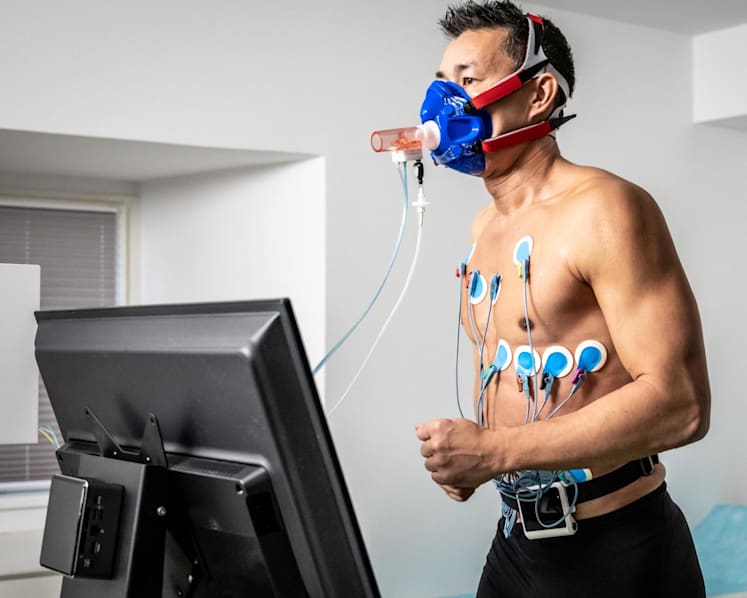
The highest oxygen uptake achieved during the test is recorded as VO2 max in millilitres of oxygen per kilogram of body weight per minute (ml/kg/min). “As a rough reference, adult men often aim for around 35 to 45ml/kg/min, while adult women often aim for around 28 to 38ml/kg/min, although athletes and highly trained individuals may score significantly higher," said Jamilson.
To answer the question, “a high VO2 max simply shows that someone performs well physically”, said Dr Bharat. “It does not exclude underlying heart disease.” He explained that some individuals with serious cardiac conditions have excellent fitness levels and may remain symptom-free until a major event occurs. “Fitness and heart health are related but they are not the same thing.”
Your best bet is still a structured medical assessment to identify hidden cardiovascular disease, said Dr Bharat. This is particularly so “in older athletes or those with risk factors such as high cholesterol, high blood pressure, diabetes, smoking, or a family history of premature heart disease”.
Jamilson agreed. “The VO2 max test is not a diagnostic test. If someone experiences chest pain, unexplained shortness of breath or fainting, they should be evaluated by a doctor.” “However, for individuals who have already been medically cleared, VO2 max testing provides valuable information for improving fitness, health and athletic performance.”

WHAT ARE THE TESTS TO ASK YOUR DOCTOR ABOUT?
Start with your general practitioner or family physician, advised Dr Bharat, who can determine which tests are appropriate. Generally, you’re fine if you clear these basic tests:
- Blood pressure: Ideally, below 130/85 mmHg.
- Lipid profile: Aim for a low-density lipoprotein (LDL) level below 2.6 mmol/L; higher-risk individuals may need significantly lower targets.
- Blood sugar: Within the “normal” range, depending on the test performed.
- Resting electrocardiogram (ECG): Within 60 beats per minute (bpm) to 100bpm. “A lower resting heart rate is generally a sign of good cardiovascular fitness because it reflects a more efficient heart,” said Dr Bharat. “However, this is only true if the individual feels well and has no underlying heart rhythm problems.”
SIGNS TO STOP ON RACE DAY
Immediately seek urgent medical attention should you experience any if the following signs during the race:
- Chest pain or tightness
- Unusual shortness of breath, that is, out of proportion to the intensity of the exercise
- Dizziness or feeling faint
- Palpitations or a racing, irregular heartbeat
- Sudden extreme fatigue or weakness
“Not everyone needs advanced imaging or tests,” qualified Dr Bharat. “These are usually recommended based on age, symptoms, family history or cardiovascular risk factors.” But if you do, the tests may include:
- Echocardiogram – an ultrasound scan of the heart that shows its structure and how well it is pumping blood.
- Treadmill stress test – The patient walks or runs on a treadmill while their heart activity is being monitored to see how the heart performs under physical exertion.
- Holter monitor – A small portable device is worn for 24 to 48 hours (or longer) to continuously record the heart's electrical activity to detect irregular rhythms that may not show up during a standard ECG.
- CT calcium score – A specialised CT scan that measures calcium deposits in the coronary arteries, which can indicate the presence and extent of plaque build-up and help assess heart disease risk.
- CT coronary angiogram (CTCA) – A detailed CT scan that produces images of the coronary arteries to check for blockages or narrowing that could restrict blood flow to the heart.