Red flag or normal behaviour? How social media is making your relationships seem worse than they are
From “divorce him” to “your parents are toxic”, social media is full of content that can sour how we see relationships. But 10-second reels rarely capture the full story, and instead can make normal relationship struggles feel like serious issues.

Social media may be encouraging you to cut ties with the people closest to you. (Photo: iStock/Simon 2579)

This audio is generated by an AI tool.


I was scrolling through Instagram the other day when I came across a video that caught my attention.
It showed a mum with a newborn strapped to her, rolling her eyes as she juggled bags of groceries, while her husband stood nearby, looking stressed on his phone. The text on the video read: “POV: You married a Google Maps idiot”.
I chuckled at the reel, which had over 3 million views. It reminded me of the times my husband and I struggled with Google Maps – or any seemingly simple app – especially in the newborn trenches.
The comments, however? They weren’t as kind.
The top comment, with over 20,000 likes, read: “Divorce him, babe.”
Another added: “I can’t stand when competent women marry stupid losers who can’t even use an app as easy as Google Maps. Wife, start using your brain and LEAVE.” Ouch.
The thing is, I wasn’t surprised. I’ve seen many similar reactions like this. A user posts a less-than-10-second reel about a moment in their relationship, and suddenly, thousands of people weigh in with the same negative conclusion.
And it’s not just in the comments, it’s in the content itself. I see the same message and heavy terms appear across videos about parents, siblings, even lifelong friends: This is why they're bad or "toxic", these are "narcissistic" signs you need to look out for, this is how your parents are "abusing" you. Avoid them, leave them, cut them off.
While these portrayals can help people in genuinely abusive situations feel seen and validated, they can have a very different effect on someone who is simply having a bad day.
Instead of offering perspective, social media can amplify those negative feelings, making relationships seem worse, more broken, and more final than they actually are.
At its most extreme, social media doesn’t just reflect how we feel about our relationships, it can even nudge us towards walking away from them, often before we’ve fully worked through them in our own lives.
HOW THE ALGORITHM BRINGS NEGATIVITY INTO YOUR FEED
Associate Professor Patrick Williams, who teaches sociology at Nanyang Technological University (NTU) and specialises in digital media and online youth subcultures, sheds some light on how this happens.
The first thing to take note of is the nature of social media itself.
“On one hand, social media brings people together, but on the other, it can be very 'Me'-oriented,” Assoc Prof Williams said. “You have a lot of choice on the platforms. You can participate in whatever you want, and whatever you don’t want, you just ignore or unfollow. It centres you, your feelings, reactions, and interests.”
When coupled with how algorithms work – sorting through massive amounts of content to prioritise what keeps users engaged – social media becomes a highly personalised feed that continuously adapts to you, he added.
“If you see content that you can relate to, you may feel validated,” he said. “Validation feels good, so you engage more, whether by liking the post or simply spending more time on it. That engagement and time then contribute to the algorithm that influences what you will see next. It pulls you toward content you may not even be seriously interested in, and suddenly you’re surrounded by the same kinds of content.”
On one hand, social media brings people together, but on the other, it can be very 'Me'-oriented ... It centres you, your feelings, reactions, and interests.
So for those of us who spend a lot of time on social media, the pervasiveness of the content can shape how we view our lives, and this becomes significant when it comes to relationships.
All relationships come with moments of frustration, irritation, or doubt. That is simply part of living with another person.
But on social media, those moments don’t exist in isolation.
Assoc Prof Williams explained that when someone is already in a negative emotional state, perhaps after an argument or a bad day, they are more likely to linger on content that reflects those feelings.
That brief moment of engagement is enough for the algorithm to take note.
“Even a few extra seconds spent watching a video about an inconsiderate partner or a post about difficult parents can signal to the algorithm that this is what resonates with you,” he said. "This content is what you’re likely to spend more time on, so the algorithm makes sure that you’ll continue to see more of such negative views on family and relationships."
Over time, what began as a fleeting frustration can start to feel like a defining pattern of your relationships – not because it actually is, but because it is constantly being reinforced by what you continue to see on your feed.
HOW SOCIAL MEDIA STRIPS RELATIONSHIPS OF CONTEXT
In addition to being highly validating, the brevity and fast-paced nature of social media also strip away the context behind people’s real-life experiences, which are often far more nuanced and deeper than what is shared online.
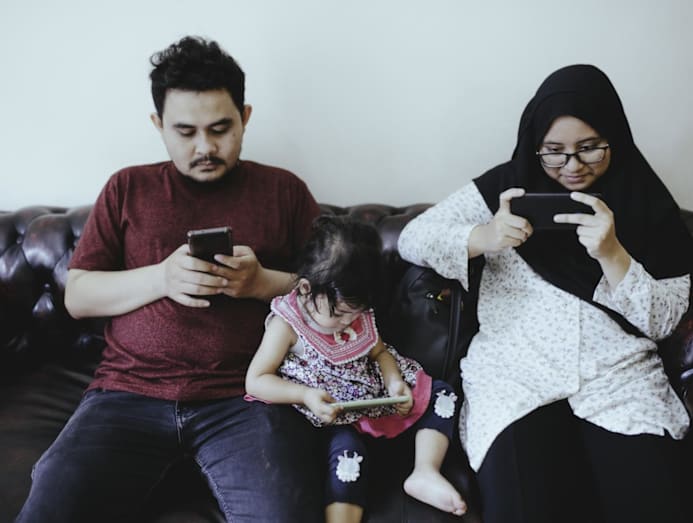
Assoc Prof Williams said that relationships are inherently complex and layered. But on social media, those layers are reduced into short videos and easily digestible advice, often packaged into polished, bite-sized content.
Sometimes, the variety and ease of accessibility to such content can be helpful.
“It puts new perspectives into people’s heads and broadens their horizon of possible responses to problems in their families in a very quick and accessible way,” Assoc Prof Williams said. “A generation ago, you might only see one way of dealing with a family problem. Now you can see glimpses of many types of solutions, including from cultures far beyond your own.”
On one hand, this can be especially meaningful for those in genuinely harmful or abusive situations.
Clinical psychologist Mahima Didwania from The Other Clinic explained that individuals dealing with traumatic relationships may feel seen, understood, and less alone when they encounter stories or advice related to similar experiences online.
A generation ago, you might only see one way of dealing with a family problem. Now you can see glimpses of many types of solutions, including from cultures far beyond your own.
The problem arises when people who are not in abusive relationships begin to see themselves in those who are.
“When a post summarises ‘toxic' red flags in a spouse or ‘narcissistic' behaviour in a parent in under 10 seconds, it becomes easy to draw parallels to one’s own life, even when the reality is far different,” Didwania, who has provided therapy services to families and couples for over a decade, explained.
This can lead normal moments of frustration – dealing with disagreements with your parents or when your spouse genuinely forgets a task – to feel like serious warning signs. What was once seen as part and parcel of the ups and downs of a relationship may instead be immediately interpreted as a red flag. And rather than sorting and working through reconciling those supposed red flags, people may just choose to walk out.
“A social media influencer summarising toxic red flags or sharing how it’s okay to walk out of a relationship might be a message someone in an abusive situation needs,” Didwania said.
“But the same message can be unnecessarily destructive for someone who is simply dealing with everyday frustrations, especially when taken out of context. All these major decisions need to consider the details of your life, something social media will never fully understand.”
THE REAL-LIFE COMPLEXITIES BEHIND RELATIONSHIPS
Beyond understanding how social media works, it is also important to consider how carrying a negative view of our relationships affects us.
Didwania explained that one of the first consequences is a reduced ability to cope with difficulty.
“Some people get into a pattern: When things get hard, they leave, they blame others besides themselves, they never learn conflict resolution, sitting with discomfort, self-reflection or managing differences,” Didwania said.
“As a result, they struggle to form long-term relationships. All relationships have difficult times, and working through them builds emotional resilience, empathy, self-awareness, and deeper connection.”
There are also many steps people can take before cutting someone off, such as setting boundaries or attempting reconciliation, but social media rarely allows space for the kind of reflection and emotional work that usually takes months or even years.
Another concern is how social media leads people to misuse language when describing their relationships.
Dr Fauziah Shah, a clinical psychotherapist and founder of Petra Counselling, noted that many people adopt heavy terms without fully understanding their meaning.
“People hear words like ‘toxic’, ‘narcissistic’ or ‘gaslighting’, and start applying the vocabulary to their own lives without always understanding how serious those terms are,” she said.
“They may not have thought about their relationships in those terms before, but after repeated exposure on social media, they begin to think, ‘Oh, my relationship is toxic' or 'My parents are abusive.’”
She added that this can lead to false perceptions of the people around them.
“Social media often introduces these terms without context, and sometimes the people presenting them are not even qualified experts,” she said. “People may end up feeling like they relate to these strangers and draw conclusions about their personal relationships, when the reality is far more nuanced.
“There are also many steps people can take before cutting someone off, such as setting boundaries or attempting reconciliation, but social media rarely allows space for the kind of reflection and emotional work that usually takes months or even years.”
When these negative perceptions build up, some people may decide to cut ties completely, often without fully considering the long-term impact, Dr Fauziah said. While some may feel more at ease after going no contact with their genuinely abusive family, most who do stop talking completely to their family members feel restless, lonely, or more anger or resentment.
“Some people feel more broken – not only did they not resolve the issues in their relationships, they now also have no one to turn to,” she added.
“Isolation is a serious issue today, and it should not be taken lightly. We may think we can turn to technology or social media to ease loneliness, but what we really need are real-life relationships."
SOCIAL MEDIA: NOT EVIL, BUT NOT ALWAYS FOR US

Social media is a powerful tool and can bring about great benefits, Didwania said. “However, the power comes with an even more pressing need to recognise its limitations.”
With the rise of AI chatbots and online personalities increasingly replacing real conversations, Didwania emphasised the importance of grounding ourselves in real relationships.
“Influencers don’t actually know you and how you’re like with your parents, your spouse,” she said. “They can sound very smart with their fancy terms, but you can’t replace real, genuine advice with a 10-second reel, especially if they come from people who know nothing about you.”
More importantly, social media cannot capture the full context of your life, including your family and social history, your cultural and religious values, your understanding of the people around you, and your quirks and personality.
For those dealing with genuinely difficult or distressing relationships, both Didwania and Dr Fauziah emphasised the importance of seeking professional help who can distil what’s really going on in the relationship before allowing social media to make the life-changing decisions for them.
For those who may not have immediate access to therapy, Didwania said the first step is awareness.
“People need to first and foremost be aware of how social media shapes perception,” Didwania said. “It’s important to remember that before making decisions we may later regret, especially when it comes to the relationships that matter."
It brought me back to the initial reel that made me pause my scrolling. Amid the thousands of snarky comments, the user had pinned her own comment, for everyone to see:
“Everyone, you don’t know me and only saw 10 seconds of a reel on my life that was meant to make me laugh! My husband can be an idiot, but I love him and I have my dumb moments too. Spend more time off this app, stop asking strangers to get divorced, and go hug the people you love!”