Gym trainer Samuel Lim guided 2 visually impaired athletes during recent Hyrox Singapore competition
Samuel Lim tells 8days.sg he was also worried about losing his voice, a critical tool when guiding visually impaired athletes through a race.
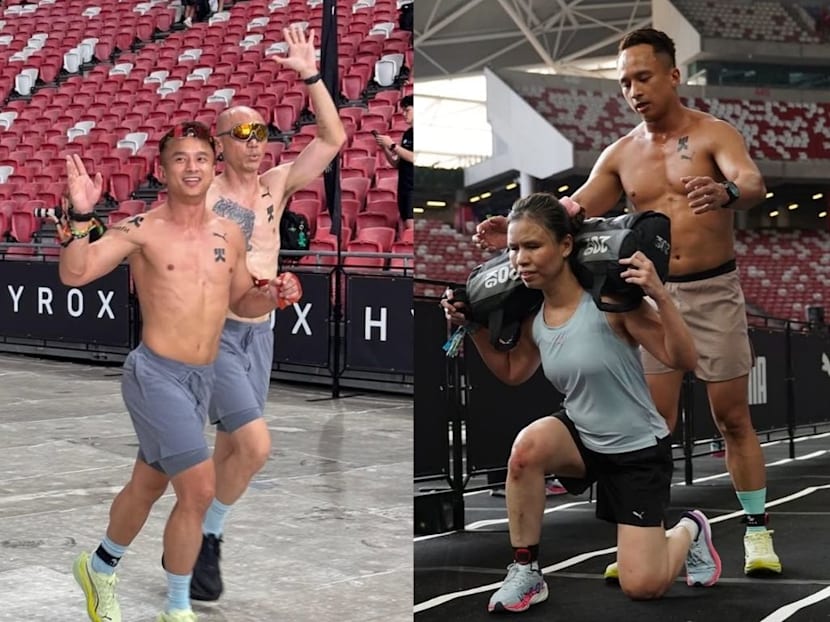
Singaporean gym trainer Samuel Lim teamed up with two visually-impaired athletes for Hyrox Singapore 2026, guiding them through the course with his voice. (Photos: Instagram/thatunclesam)

This audio is generated by an AI tool.
With Hyrox Singapore 2026 wrapping up over the weekend (Apr 3 to 5), social media has been flooded with personal bests, sweaty selfies and celebrity sightings.
But for gym trainer Samuel Lim, his concerns for the race weren't about clout, timing or star-spotting – he was worried about losing his voice and navigating the circuit with exercise bands.
The 44-year-old coach from FireCity, teamed up with two visually impaired athletes for the race weekend. Yes, that meant he completed not one, but two Hyrox races over two days.
Lim partnered with BK, 46, and Ng Pei Pei, 49, guiding them through the physically demanding race format.
Speaking about the physical toll, he said: “I’m definitely very ‘broken’ after two days of racing, plus I’m not very young anymore.”
“But I’m also overwhelmed with all the support and messages. Whether it’s for them or for me, it means a lot."
Lim tells 8days.sg his gym has been been working with visually impaired athletes since July 2025.
“We started from small, guided training sessions, and have gradually built more structured classes for race preparation,” he shares.
While this was Ng’s first Hyrox race competing in the Women’s Doubles, BK returned for his second, levelling up to the more demanding Men’s Doubles Pro category. “When I first suggested the November Hyrox to BK last year, he didn’t even know what it was. Now he says he’ll only do it if I’m his guide,” says Lim.
As for Ng, Lim intentionally chose to partner with her.
“I was looking for a female adaptive athlete for mixed doubles. It became more than a race, it was about showing what’s possible,” he says.
He trained with her for three weeks, focusing on key stations like the sandbag lunges and wall balls. No small feat given the weight involved.
Of course, no one was expecting a walk in the park and Lim tells us that during race day, there were many concerns that most would take for granted.
“I was concerned about people cutting in front of them, as that happens a lot in these sorts of races. For us who can see perfectly, it is fine. But for them, they can’t react. So I had to be, like, 200 per cent focused in terms of spatial awareness, looking up, the front and the back for them as well,” he explains.
To help them navigate during the runs, Lim used a resistance band so his partners could follow his movement.
Ironically, one of Lim's biggest concerns had nothing to do with his legs or fitness – he was worried about losing his voice as he had spent the day before his races cheering for his friends.
“I was quite scared as [having] no voice, means no eyes [for them],” he says sheepishly.
When 8days.sg mentioned how tense he looked during the wall ball station with Ng, even pushing a falling ball away mid-race, Lim didn’t deny it.
“I know that she can reach the target, but with the fatigue and the weight on [race] day, I was 100 per cent on the lookout to make sure that the ball doesn't hit her face,” he explains.
Preparing visually impaired athletes goes far beyond reps and sets, and Lim says it starts with imagination.
“For example, they needed to imagine the movements first before using the machine. I had to let them touch, and get a feel, have a visualisation or what the machines are like, and how to handle them. With a visually impaired person, we need to be a lot more sensitive to their imagination, and to give them what they need to hear and feel,” explained Lim.
Since the Hyrox weekend, Lim says interest has been encouraging, from the visually impaired community, as well as others who have shown interest in being a guide.
“Currently, we have more sighted partners than visually impaired athletes, but I’m confident that will grow. There’s clearly interest from the visually impaired community to step into training and eventually into racing. it’s just about continuing to build awareness and providing the right support structure,” he said.
This story was originally published in 8Days.
For more 8Days stories, visit https://www.8days.sg/