Warong Nasi Pariaman closing: Long-time customers mourn loss of 'authentic' nasi padang in Singapore
CNA Lifestyle heard from customers who were surprised and saddened by the impending loss of the 78-year-old Kampong Glam fixture.
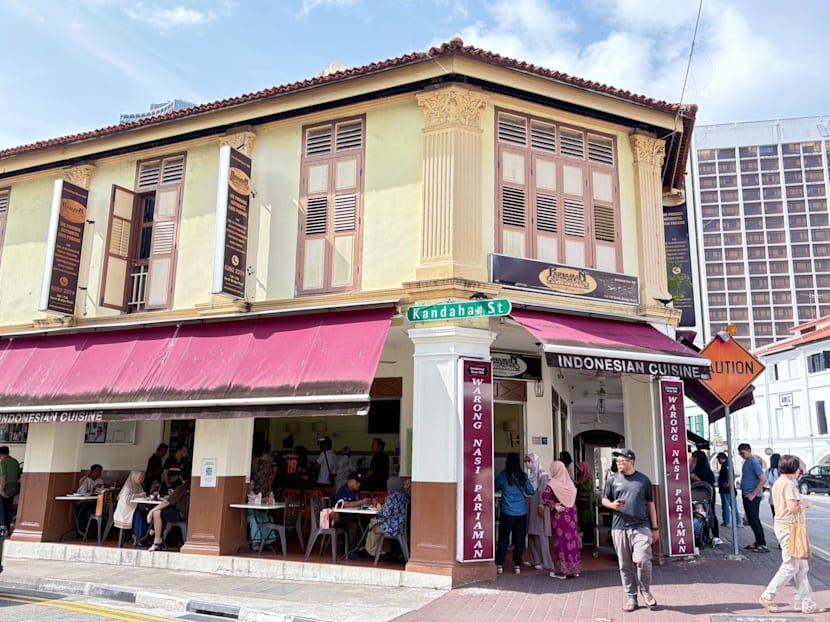
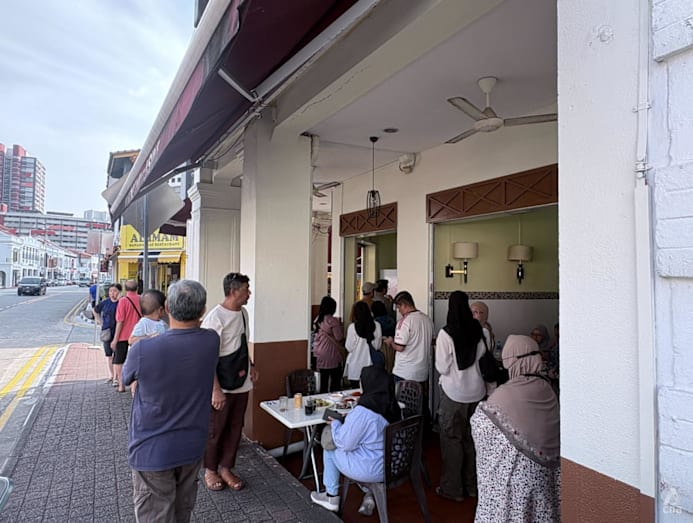
The crowd at Warong Nasi Pariaman on Jan 22, 2026, after the popular nasi padang eatery announced that it would close at the end of January. (Photo: CNA/Grace Yeoh)

This audio is generated by an AI tool.


Over a hundred people turned up at Warong Nasi Pariaman on Thursday (Jan 22), from as early as 9am, to get their last fix of “authentic” nasi padang.
The 78-year-old popular nasi padang eatery, better known as Pariaman, located at Kandahar Street announced on Tuesday that it was closing on Jan 31.
It’s also said to be Singapore’s oldest nasi padang stall, having been a familiar fixture in Kampong Glam since it was founded by Haji Isrin from Indonesia’s West Sumatran city of Pariaman in 1948.
According to several customers who were surprised and saddened by the news, it was also a staple across several generations of their families.
There was a shared sense of loss, but also gratitude, among customers both online and in person for Pariaman’s contributions to Malay food in Singapore. Some also expressed hope that it could still continue or reopen elsewhere.
Acting Minister-in-charge of Muslim Affairs Faishal Ibrahim said in a social media update on Wednesday that he’d visited the family behind Pariaman upon hearing the news.
“For many families, including mine, a visit to Kampong Gelam has long included a meal here. The value of shops like Pariaman is truly immeasurable in our society,” he said.
“I shared with the family that I hope they know that they are deeply appreciated, and that their food has been part of many Singaporeans’ shared meals and memories over the years.”
He said he’d also asked his colleagues from various government agencies to work with the owners to understand how they could help.
CNA Lifestyle has contacted Associate Professor Faishal for further comment.
One of Pariaman’s owners, Abdul Munaf Isrin, declined to comment when CNA Lifestyle contacted him on Thursday. He’d also declined to share the reason for the closure when interviewed by Berita Harian on Tuesday.
But it was clear the loss was felt by his family too.
His grand-nephew Adam Bakri, who helps out at the stall from Friday to Sunday, shared over text message that he has been working at Pariaman since the end of 2024.
The 19-year-old felt “very proud to continue” his family’s legacy as the fourth generation, and now that it was closing, he felt “like a part of me has been taken away”.
“I do realise the impact it has (on Singaporeans), because I have met many customers who have been eating here (since before) I was born. They always tell me stories about their own experience dining at Pariaman.”
Even before I arrived for breakfast on Thursday, I didn’t realise I would hear such stories via customers I contacted online raving about the food and customer service.
FRIENDLY OWNERS
The owners were known to be friendly and welcoming, treating customers as one of their own, even if it were only their first few visits, many said.
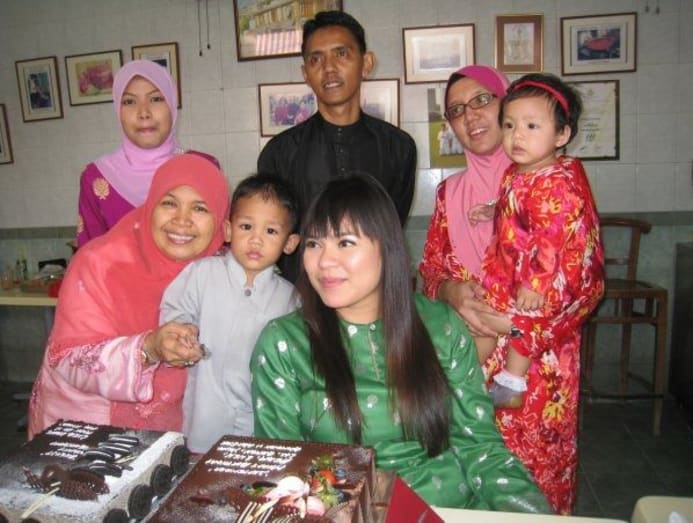
Wini, a regular customer in her early 40s, recalled that her family was invited to the wedding of the owner’s daughter around the late 1990s.
“It was lovely. It was held on their premises. They closed off the street for the guests to enjoy the wedding lunch.”
Four generations of Wini’s family, from her grandparents to her children, have found comfort in Pariaman. Their favourite dishes include ayam bakar (charcoal-grilled chicken), sotong gulai (squid curry), rendang (dry curry) and begedil (deep-fried potato patties).
“I will definitely miss the people from Pariaman. They are just so warm and lovely,” she said.
Regular customer Darry Lim, 69, said in a Facebook comment on Pariaman’s announcement post that its nasi padang was his favourite.
The ikan bakar (charcoal-grilled fish) with chopped green and red chilli, onion and black soya sauce, and telur dadar (thick, fluffy omelette) were “truly awesome”, he told me separately, adding that he would bring many of his overseas friends to Pariaman when they visited Singapore.
Plus, “the owner is very friendly”, he said of his fondest memories of the eatery. “His smile is as delicious as his food.”
“VERY IMPORTANT” TO THE MALAY COMMUNITY
On Thursday morning, the line was long, and it would only grow over the four hours that I hung around, as regulars and first-timers alike showed up to support the beloved institution.
It was the first day of business since the owners had announced that Pariaman would shutter. The stall is not open on Wednesdays.
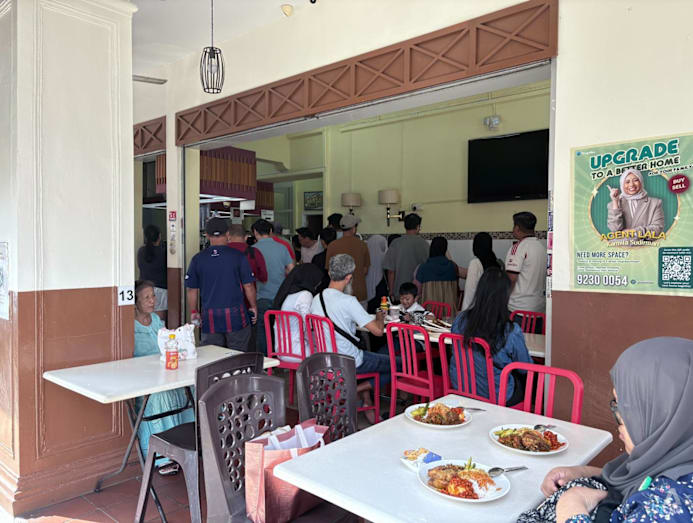
Joining the queue around 9.45am was long-time customer Farhan, who decided to drop by the stall on his day off from work.
The 43-year-old first learnt about Pariaman in his 20s from a Chinese colleague, he said. He would often break fast with his co-workers over a sumptuous plate, especially with his favourite dish, ayam bakar (Indonesian charcoal-grilled chicken).
Though Farhan hadn't had the chance to visit often, he was still shocked by the news. The eatery is a “well-known place”, and he “didn’t think it would close down”.
Later, a 62-year-old housewife shared while waiting for her daughter who was in the queue that she, too, hadn’t visited the stall often.
Lina, whose family once stayed with the Pariaman family, was usually spoiled for choice by the variety of food in the Kampong Glam area.
But Pariaman’s nasi padang, she admitted, has a “very authentic” taste. Even though the recipe has been passed on throughout several generations, the smell remains just as alluring.
“It is a very important place to the Malay community.”
A pair of sisters-in-law, before digging into their nasi padang, also recalled their memories of the “Malay kampung” vibe at Pariaman, having grown up with the food.
One of the women, Yani, said Pariaman’s dishes carried an “old school” taste, which was to her liking.
“In this area it’s very hard to find good food, mostly modern.”
“AUTHENTICITY” WAS PARIAMAN’S STRENGTH
For the same reason, food historian Khir Johari touts Pariaman as his go-to place for “authentic” nasi padang in Singapore. It’s not a word he uses lightly, he said.
“‘Authentic’ is not a badge. It’s a relationship: something is authentic to something else – to the cuisine’s grammar, to the regional logic, to a technique, to a time period, to a particular community,” he said.
“It’s about this fidelity to a flavour system, to the cultural intention. When you prepare all this food, it’s not one person in the kitchen doing the work too. It brings people together.”
Nasi padang hails from the Minangkabau people of West Sumatra, Indonesia, where Padang happens to be the capital.
Pariaman has been the one place that “truly believed in honouring the legacy of their founders in the true sense of what Minangkabau food is”, said Khir, who authored The Food Of Singapore Malays: Gastronomic Travels Through The Archipelago.
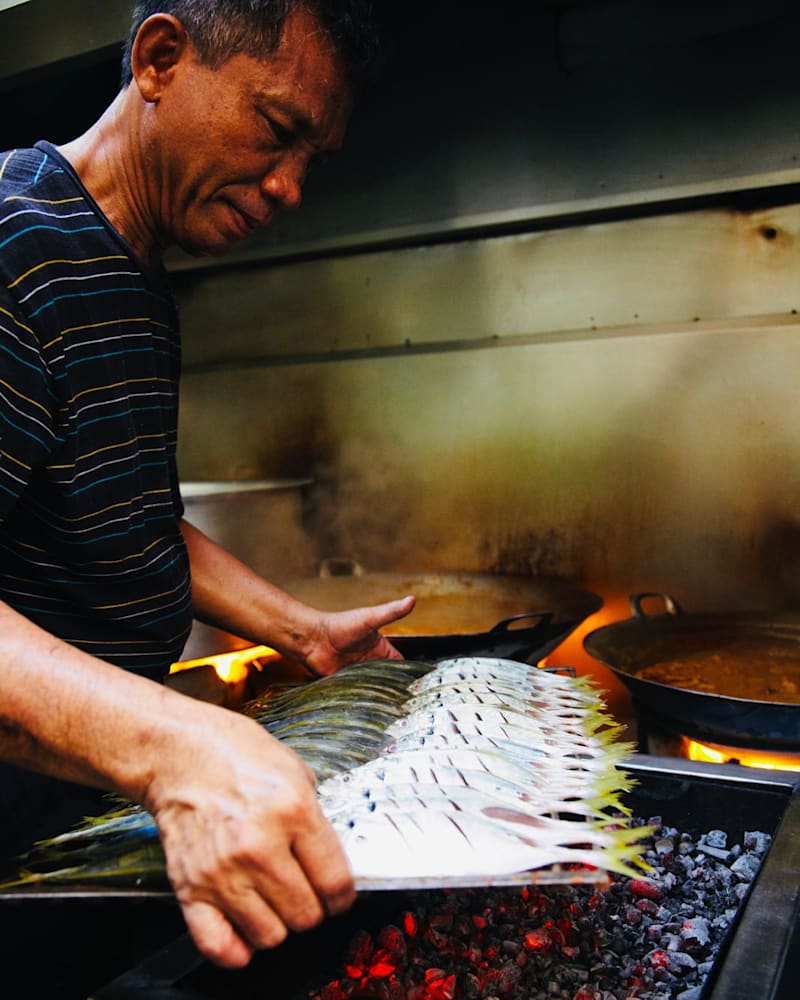
There are few eating places in Singapore where you can walk in and “know that it has various nomenclature”, he added.
At Pariaman, he pointed out, the three progressive stages of a single, long-cooking Minangkabau culinary process make its food great: gulai, kalio and rendang.
Convenience in food preparation is not of utmost priority, unlike in modern eateries.
“This is about respect too. There is an intimate understanding of the Minangkabau food. So I was really devastated (by the news).”
When the food is authentic, people return, even after they’ve moved away, it seems. Khir recalled approaching a pair of elderly Chinese men a few years ago at Pariaman, who said they used to work in the blacksmith trade in Kampong Glam.
Even though they now lived in Sengkang and Hougang, they returned for the food and connection to the community.
“I had a lump in my throat. They might have left Kampong Glam but Kampong Glam hasn’t left them,” said Khir.
This was the case for long-time customer Wini too, whose parents grew up around Kampong Glam. She now lives in Sembawang and often makes the trip across the island.
“You know, when you go overseas, you will somehow crave local food. For our family, that is the food from Pariaman,” she shared via text message on Wednesday.
“Each time we come back from an overseas trip, we will look for Pariaman food. It’s our family go-to for nasi padang.”
Wini and her family were shocked by the news as they’d just visited two weeks ago. But she resolved to visit and make more good memories before it closed.
On Thursday morning, she was at Pariaman dining alone. We spotted each other from a distance and exchanged a knowing glance that said everything: This place is special. Thank you for showing up in support.