Bloating, fatigue, constipation: The colorectal cancer symptoms women often dismiss
Colorectal cancer is the second most common cancer among women in Singapore – but its warning signs are often mistaken for other health conditions and screening is frequently overlooked. From subtle symptoms to hard-to-detect tumours, here’s why it can go undetected.

Colorectal cancer is the second most common cancer among women in Singapore, yet its symptoms – and health screening for it – are often overlooked. (Photo: iStock/Keeproll)

This audio is generated by an AI tool.
Colorectal cancer is the second most common cancer among women in Singapore. Yet, it receives less attention than other female cancers, such as breast or cervical cancer.
Part of the problem, experts say, is the misconception that colorectal cancer is a male disease, or something that affects older adults.
“In reality, colorectal cancer affects both men and women,” said Clinical Assistant Professor Evelyn Wong Yi Ting, consultant at the Division of Medical Oncology at National Cancer Centre Singapore.
“We need to do more to highlight that colorectal cancer is just as important for women, so that women do not become complacent about screening or dismiss warning signs and symptoms,” she added.
COLORECTAL CANCER IS RISING – AND YOUNGER WOMEN ARE NOT SPARED
Early-onset colorectal cancer in men and women under age 50 has nearly doubled over 50 years, rising from five per 100,000 in 1968 to 10 per 100,000 in 2019, noted Dr Calvin Ong, senior consultant general surgeon at Colorectal Clinic Associates.
While colorectal cancer is still more common in men, Dr Ong noted a “worrying uptrend” in women under 50.

One study analysing cases from 1968 to 2019 found that among women aged 20 to 49, early-onset colorectal cancer increased by 2.1 per cent per year up to 1994, then 0.41 per cent per year thereafter. Early-onset rectal cancer (a type of colorectal cancer that starts in the rectum) increased by about 0.93 per cent per year – reflecting a “persistent, long-term rise” in diagnoses at a younger age, said Clin Asst Prof Wong.
YOUR LOVE FOR BACON AND LUNCHEON MEAT IS A MAJOR RISK FACTOR
Nearly three in four new colon cancer cases are diagnosed in individuals with no significant family history, Dr Ong said. While some risk factors, like family history, age and ethnicity, are beyond one’s control, lifestyle habits play a major role in colorectal cancer risk.
Dr Melvin Look, consultant surgeon and director of PanAsia Surgery, said a growing shift towards more “westernised” lifestyles in Singapore, including processed foods, sedentary routines, and lower fibre intake, were possible reasons behind the rise in certain types of colorectal cancer in Asia.
Processed meats such as sausages, bacon and ham are classified as a “Group 1 carcinogen”, meaning there is sufficient evidence to show that they cause cancer in humans. Research shows that eating just 50g daily (about one hot dog or two slices of bacon) can increase colorectal cancer risk by around 18 per cent, said Dr Look.

Even unprocessed red meat like beef, pork, and lamb is considered “probably carcinogenic”, he added.
The American Institute for Cancer Research and the American Society of Clinical Oncology recommend avoiding all processed meat and eating no more than around 510g (three to four servings) of red meat each week to reduce cancer risk, according to the American Cancer Society website.
On the flip side, there is evidence to show that fibre is protective. “A 10 per cent reduction in risk has been observed for every 10g of fibre consumed daily,” said Dr Look. As a guideline, one cup of chopped broccoli contains 5g of fibre, 1 medium banana contains 3g of fibre, and one slice of wholewheat bread contains 2g of fibre.
BEING OBESE IS ALSO A RISK
“While obesity is a risk for both genders, women with abdominal obesity and high Body Mass Index (BMI) are at higher risk of developing colorectal cancer,” said Dr Ong. “Additionally, weight gain after age 18 is a stronger risk factor for early-onset colorectal cancer in women.”
Women with abdominal obesity and high Body Mass Index (BMI) are at higher risk of developing colorectal cancer.
A study of over 85,000 women published in JAMA Oncology found that those with obesity (BMI of 30 or higher) nearly doubled their risk of developing colorectal cancer early, compared with women with a BMI of 18.5 to 22.9.
Other lifestyle factors also raise risk, such as smoking, alcohol consumption, obesity, and lack of physical activity. Women who smoke also have a higher risk of rectal cancer compared to male smokers, added Dr Ong.
SOME COLORECTAL CANCERS MAY BE HARDER TO DETECT IN WOMEN
Most colorectal cancers occur on the left side of the colon but a gradual shift towards more right-sided cancers has been noted in Asian populations, with some studies finding a higher likelihood of right-sided tumours in women, said Dr Look.
According to Dr Ong, right-sided tumours tend to cause fewer symptoms and present much later, compared to left-sided tumours, which delays diagnosis.
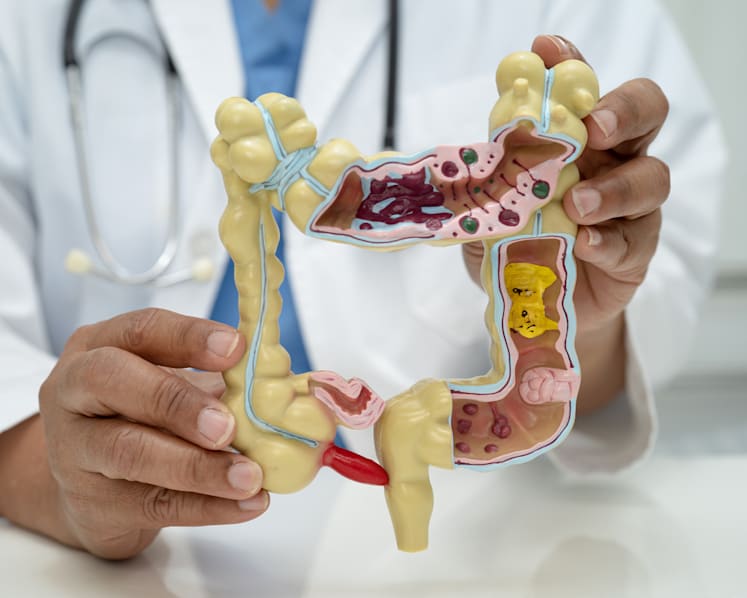
Food residue from the small intestines enters the right colon as a slurry liquid after most nutrients from the food we eat are digested, Dr Look explained. As this mixture passes along the colon, water, salts and vitamins are absorbed to compact it into solid faeces.
“Left-sided colon cancers may therefore present with constipation or pain, as there is physical obstruction to the passage of the solid faeces,” he said. “Right-sided cancers, on the other hand, may remain undetected for a long time as the liquid contents do not get blocked until it reaches an advanced stage.”
Emerging research also suggests there may be biological differences in how colorectal cancer develops in women, potentially contributing to more aggressive cancer growth in some cases, Dr Look added.
SYMPTOMS CAN LOOK LIKE COMMON WOMEN’S HEALTH ISSUES
For many women, colorectal cancer symptoms may be subtle or overlap with common conditions. For example, women consuming iron or calcium supplements for anaemia and osteoporosis often experience constipation, and this may mask symptoms, said Dr Ong.

Fatigue may be attributed to menstrual blood loss or iron deficiency, while abdominal bloating and changes in bowel habits may be mistaken for hormonal changes, irritable bowel syndrome, or diet-related symptoms, said Clin Asst Prof Wong.
“Additionally, some women may delay seeking medical attention due to caregiving responsibilities or the assumption that they are too young to be at risk,” she added.
Dr Ong noted that nearly three in five patients, both male and female, are diagnosed at a late stage (Stage 3 or 4). He recalls a 39-year-old patient who had persistent fatigue for over a year, and was later diagnosed with Stage 3 cancer.
“She attributed the fatigue to her heavy menses, and didn’t undergo further evaluation for her anaemia,” said Dr Ong. The patient sought help after she kept vomiting from a bowel blockage, and had to undergo emergency surgery.
Symptoms to look out for include unexplained weight loss, persistent fatigue (often linked to anaemia), changes in bowel habits or stool consistency, blood in stools or rectal bleeding. There may be general abdominal discomfort, like bloating, fullness, cramps or gas.
“In general, pay attention to symptoms that are new, persistent, keep getting worse or unusually severe,” Clin Asst Prof Wong said.
MAKE COLORECTAL SCREENING PART OF YOUR WOMEN’S HEALTH ROUTINE
Clin Asst Prof Wong advised women to incorporate colorectal screening as part of their routine preventive health, alongside breast and cervical cancer screening, rather than as something separate.

“For women who are already attending regular health checks, this is a good opportunity to check whether they are due for colorectal cancer screening and to make it part of their usual screening schedule,” she said.
Dr Look added that the majority of colorectal cancers develop from tiny fleshy growths called polyps which take five to 10 years to grow before they undergo cancer change. These cause no symptoms or warning signs, but can be detected through screening colonoscopy, he said.
“This should be done even if you are healthy and have no family history of cancer. Screening colonoscopy has been shown to prevent cancers by removing the pre-cancerous polyp before they turn malignant,” said Dr Look.
Clin Asst Prof Wong said colorectal cancer screening is recommended from age 50 for people with no symptoms.
Screening methods include the Faecal Immunochemical Test (FIT), used to detect the presence of hidden blood in stool samples, and colonoscopy, which uses a thin flexible camera inserted through the anus. FIT should be done once a year while colonoscopy is recommended once every five to 10 years, Clin Asst Prof Wong said.
“If you have a family history of colorectal or other cancers, you should start screening from the age of 40 or earlier,” Dr Look added.
CNA Women is a section on CNA Lifestyle that seeks to inform, empower and inspire the modern woman. If you have women-related news, issues and ideas to share with us, email CNAWomen [at] mediacorp.com.sg.