Threads that bind: How this Singaporean artist weaves community from discarded textiles and old clothes
By turning discarded textiles into vibrant tapestries, Natalia Tan invites strangers to slow down, reflect, and find connection with themselves and each other.
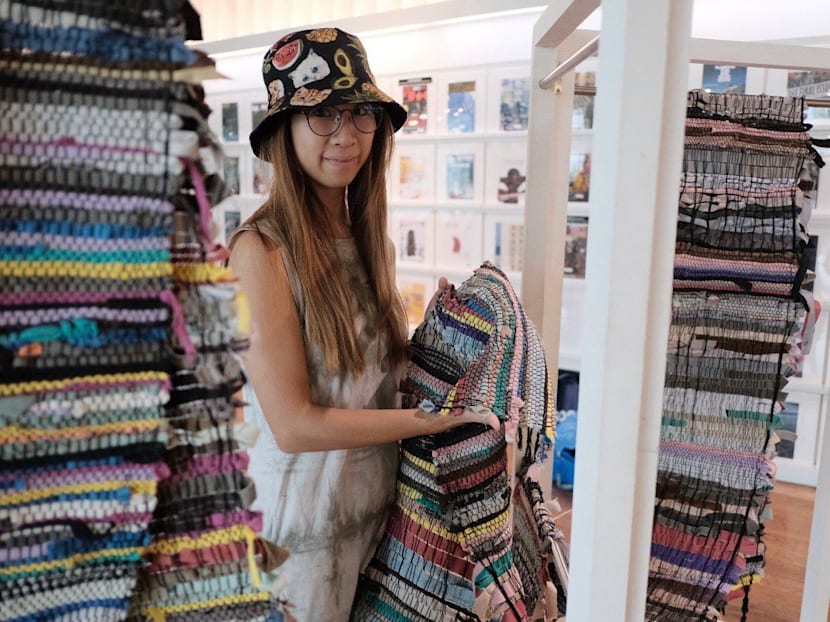
Artist Natalia Tan first discovered Saori weaving in 2014 on her maiden trip to Japan with a friend, which planted the seeds for her life’s work. (Photo: Sroyon)

This audio is generated by an AI tool.


Tucked away on the second level of Hong Lim Complex, amid a labyrinthine mix of hair salons, jewellers and the odd hipster cafe, is an unassuming shopfront that belies the gravitas of its contents.
Outside the nondescript shop unit, cardboard boxes filled with textile waste are piled high. Inside, scraps of cloth form small mounds on tabletops and shelves. Containers of all kinds – from plastic to cardboard – are packed with even more scraps.
A sewing machine, ironing board, and weaving loom round out what could well be a clothing alteration business.
It’s here that Natalia Tan holds court. The artist-educator is best known for her large-scale tapestries made of upcycled textiles, woven together somewhat haphazardly – although there is method to the madness.
The 34-year-old has worked with arts institutions like the National Design Centre, The Esplanade, Singapore Art Museum, as well as luxury brands like Christian Dior, Diptyque and Van Cleef & Arpels. Her work is collected internationally, with pieces held in Singapore, Japan, Switzerland and the United States.
It’s a weekday evening when CNA Women pays Tan a visit, and we find her freshly off the plane and surviving on two hours of sleep. She had just arrived from Kuala Lumpur, where she was invited to showcase her work at Fabrics of ASEAN, an arts-and-crafts exhibition held in conjunction with the 47th ASEAN Summit.

“Back in the day, I used to organise weaving workshops in my home,” she said. “I had two looms, and my students would be individuals or a couple of friends coming together to enjoy a lovely afternoon of making something together.
“But it was really more about the connection than what we were making. That’s been the primary thrust of my practice: The facilitation of connections, of conversations, of togetherness.”
GROWING UP GREENIE
Tan said that she has always been environmentally conscious, deeply passionate about animal welfare, and aware of how pollution affects both nature and people.
This belief system stemmed from her upbringing. “I was brought up by my grandmother, and she comes from that generation where waste is a sin,” she recalled. That idea stayed with her.
Still, her environmentalism didn’t truly take shape until she discovered weaving 11 years ago. Tan’s practice today is as much about sustainability as it is about reflection. “One of the biggest bugbears for us recently has been textile waste. We have a one-digit recycling rate for textiles – one digit!” she exclaimed, half in disbelief.
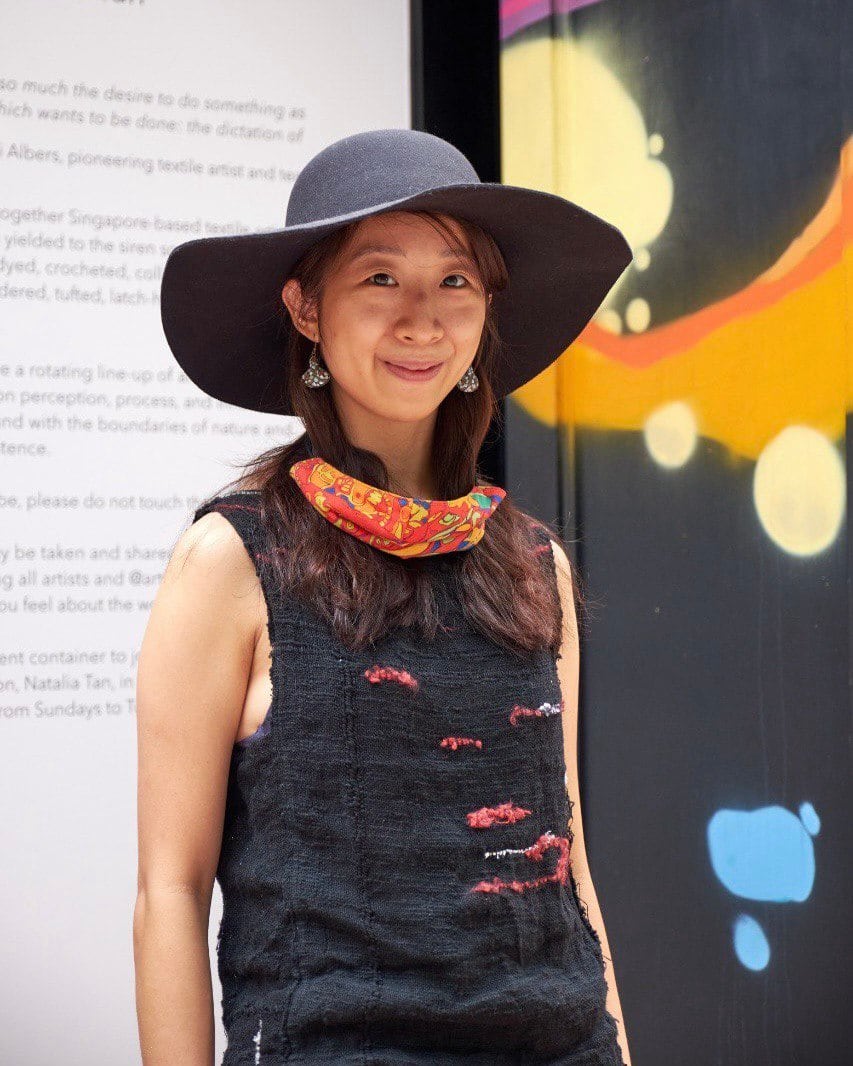
According to the National Environment Agency, only 3 per cent of clothing and textiles were recycled in 2024. “If you look at plastics, cardboard, wood – all these other forms of waste – we’re doing so well with them. But why is it that textiles are such an issue?”
Part of the problem, she explained, is both awareness and infrastructure. “You’ve seen the yellow textile bins across the island, right? A lot of people still don’t know they exist. So they end up throwing their old clothes into the normal bin, or worse, the blue recycling bin.”
SUSTAINABILITY WITH A SIDE OF STORYTELLING
To do her part, Tan incorporates donated and salvaged fabrics into her work. “People donate clothing they don’t want anymore, and I also go around to places I know will have these offcuts – seamstresses, aunties who do alterations at the market.
“I’ll get these from them. They’re from hemmed dresses and such – perfect for weaving, because what I need are long, thin strips.”
For her, these materials carry more than just texture; they hold stories. “I like working with donated textiles because I sometimes get to ask the person who gave them to me, ‘What’s the story?’
“They love these questions, because decluttering is such a sayang (Malay for regretful) thing, right? People have these piles of clothes they’ll never wear again yet don’t want to throw away. Giving them away to be transformed into something else becomes a kind of release.”
Pausing thoughtfully, she added: “It’s like shedding your old identity, your old skin, and bringing in the new. The new you.”
WABI-SABI, JUST IN TEXTILE FORM
For Tan, 2014 was a moment of transformation, the year everything seemed to converge. She had just graduated from university, started her first job, and was going to Japan with a friend for the first time.

That friend suggested they try Saori weaving. “I had no idea what it was – I didn’t even know what weaving meant. But I thought, okay, let’s do it.”
Saori weaving began in Osaka in 1969, when founder Misao Jo discovered beauty in a “mistake” she made while weaving. From that moment, she built a philosophy around freedom, individuality, and imperfection – a practice deeply aligned with the wabi-sabi spirit of finding grace in imperfection.
They signed up for a three-day intensive workshop, fitting it in between their travels. “I didn’t get to travel much when I was younger, so just being out in the world with a friend, it felt big,” she said.
Until that point, Tan had never considered herself as an “art person”. “I studied engineering all through university,” she said. “Anyone who met me back then would’ve been so surprised to know that I’d end up an artist.”
Anyone who met me back then would’ve been so surprised to know that I’d end up an artist.
Her first job was as a private tutor, which she still does today. In secondary school, friends would come to her for help with math and science and “it just continued from there”. Tan now teaches upper primary to secondary level math.
On that fateful trip to Japan, Tan and her friend found themselves in a remote, rural area in Izumi, Osaka. There, a striking red barn housed a three-storey weaving studio.
“When we first walked in, the hall was filled with looms – maybe 20 to 30 of them,” she recalled. “In the morning, it was empty, and then suddenly, people started streaming in. Everyone just quietly weaving. It was so peaceful – such a beautiful sense of community.”
STITCH BY STITCH
That tranquil encounter would plant the seed for her art. Four years later, in 2018, feeling burnt out from tutoring and searching for direction, Tan took a year-long sabbatical.
“I was questioning everything,” she admitted. Then she saw that the Saori studio in Osaka had opened a 30-day residency programme with full sponsorship. She applied, got in, and by January 2019, she was weaving in the very city where the movement began.

What was meant to be a creative retreat turned into a revelation. “I realised I didn’t tire of weaving,” she said. “It felt like I could create a sense of self again.”
Her flexible tutoring schedule allowed her to nurture both vocations. “I’ve always appreciated the stability of teaching. But I also love the rhythm of seeing students regularly – taking care of them, in a sense.”
In 2019, she brought home her first loom and began exploring the social impact of weaving.
Inspired by Saori’s humanitarian ethos – particularly its work with neurodivergent communities – she sought out local organisations that supported people with autism and Down syndrome. “I really enjoyed working with them. There was so much joy and calm in those sessions,” she said.
At the time, Tan was still weaving with “normal yarn” – cotton, wool, polyester – the kind found at craft stores. But these were expensive.
While decluttering her home one day, she had a breakthrough. “I was about to donate my old clothes – but there were things like school shirts that I knew the charities wouldn’t sell or have a use for – and I thought, why not use them myself instead?”
She began cutting fabric into strips, transforming T-shirts and textiles into weaving material. It was the birth of her upcycling practice – and it merged sustainability with storytelling.

FROM USED TOWELS AND OLD BEDLINEN TO ART
Her first major public installation came later that year, when she was invited to contribute to a National Day marketplace held in a restored heritage building – now known as KADA.
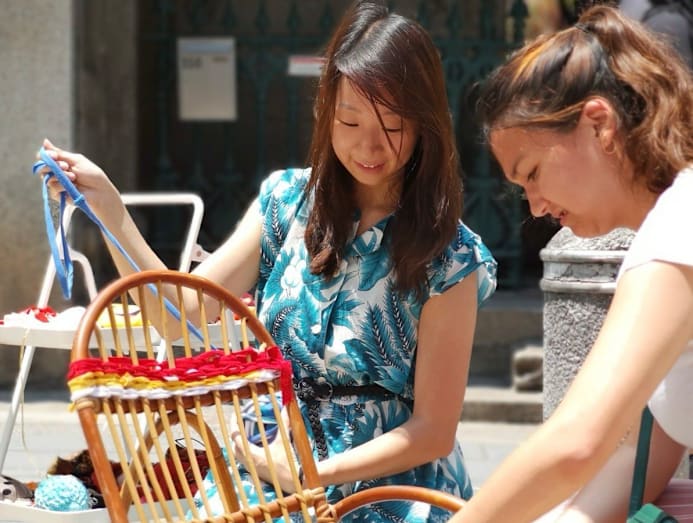
“The space was huge and empty,” she recalled. “I thought, this little weaving is going to look so lonely. So I decided to go big, and made a giant warp that covered the floor – for people to participate and weave on.”
She put out a call for fabric donations, and the community responded enthusiastically. “People sent me towels, unused clothes, even bedsheets,” she said.
From those came a sprawling woven installation – a “fairy tent” of donated cloth that brought people together in both making and meaning.
“I didn’t even think of myself as an artist then,” she said with a laugh. “But people started reaching out, saying, ‘I heard you’re this artist’.”
Soon after, commissions began to flow in – at first, private requests for wearable art, then from institutions inviting her to create participatory installations, such as -i-n-f-i-n-i-t-e-, her interactive installation at the Singapore Art Museum in February.
TREADING NEW PATHS
Lately, Tan has found herself working with clients from less-expected corners, including the finance world. One recent commission came from a firm that had just completed an office renovation and wanted to repurpose the electrical cables from their old space into an artwork.
“They wanted it as a keepsake, a reminder to value what you have, to honour the past while creating something new,” she explained. For her, the project became a meditation on continuity, on giving materials a second life and allowing stories to live on.
Another firm invited her to create a community weaving during their launch event, where guests each contributed a thread to a collective piece. “It was like signing a guestbook, but more visceral,” she said. “You end up with a tangible, visual record of connection – between the institution and the people who shape it.”
Today, her workshops continue to carry that same spirit of quiet communion. Participants weave side by side, sometimes in silence, sometimes in conversation.
She occasionally offers prompts to spark sharing, but often, the act of weaving itself is enough to open hearts. “I’ve had people tell their entire life stories to complete strangers,” she said, smiling.
Related:

CNA Women is a section on CNA Lifestyle that seeks to inform, empower and inspire the modern woman. If you have women-related news, issues and ideas to share with us, email CNAWomen [at] mediacorp.com.sg.